A trained vision model
Start with a model that has learned to identify objects in images. HASLAB's first example is a small YOLO object detector.
HASLAB is building the computing engine that will let cameras and robots run trained vision models near their sensors. Today, its software executes the pinned detector’s accelerator partition and declared host tail on tested inputs. COCO-wide accuracy through that path, an FPGA prototype, and silicon remain future work.
YOLOv8n accelerator nodes 0–217 run through the compiler and simulator. Six diagnostic inputs match 37,900,800 stored integer values exactly; COCO-wide command-path accuracy and hardware are still open.
Check the evidence →A trained AI model can recognize the defect, but a device still needs a way to run that model. HASLAB is building that missing path: translate the model into instructions, check the answers in software, and eventually run those instructions on hardware near the camera.
Start with a model that has learned to identify objects in images. HASLAB's first example is a small YOLO object detector.
The compiler turns part of that model into machine instructions. A simulator checks the results against an independent reference.
Once the complete path is proven, the design can move to an FPGA prototype and later to an open chip.
Why build it in public? Model conversion, data movement, and correctness can each make or break a real device. HASLAB makes those steps visible so others can inspect, test, and improve them. Read the project principles →
The diagram shows the intended route. Today, pinned accelerator nodes 0–217 execute through the compiler, runtime, and simulator; the declared host tail runs in Python. COCO-wide command-path accuracy and hardware stages remain ahead.
Quantization represents the model with smaller integers. The calibrated INT8 software proxy stays within the project’s one-mAP-point accuracy-loss budget.
YOLOv8n · COCO val2017 · 320 × 320
Exact report value: 0.284969Signed-symmetric INT8 proxy · 320 × 320
Exact report value: 0.2760983.11% relative loss · 96.9% retained
Exact loss: 0.887 pointsScores use the familiar 0–100 mAP scale; exact 0–1 report values remain visible for traceability. YOLOv8n · 320 × 320 · 5,000 COCO val2017 images. Both software evaluations were repeated with identical predictions. The INT8 result uses an ONNX Runtime QOperator proxy; COCO-wide HASLAB command-path accuracy and hardware measurements remain future work.
The source includes a tested numerical model, a command simulator, 46 independent test cases, and a compiler/runtime path through the learned detection head of pinned YOLOv8n. Read the exact comparison and track the remaining work.
FP8/INT8 conversion, accumulation, tensor operations, layouts, rounding, saturation, and edge cases.
Read the reference model ↗A byte-level simulator for the proposed 128-byte v0 command ABI, including memory spaces, completion, reset, and errors.
Inspect the simulator ↗46 binary fixtures and strict validation exist; independent review and the stable ABI freeze remain open.
Review the corpus ↗Nodes 0–217 compile to diagnostic and release packages. Six inputs pass exact stored-value comparisons and the declared Python host tail; COCO-wide accuracy is next.
Follow the software path →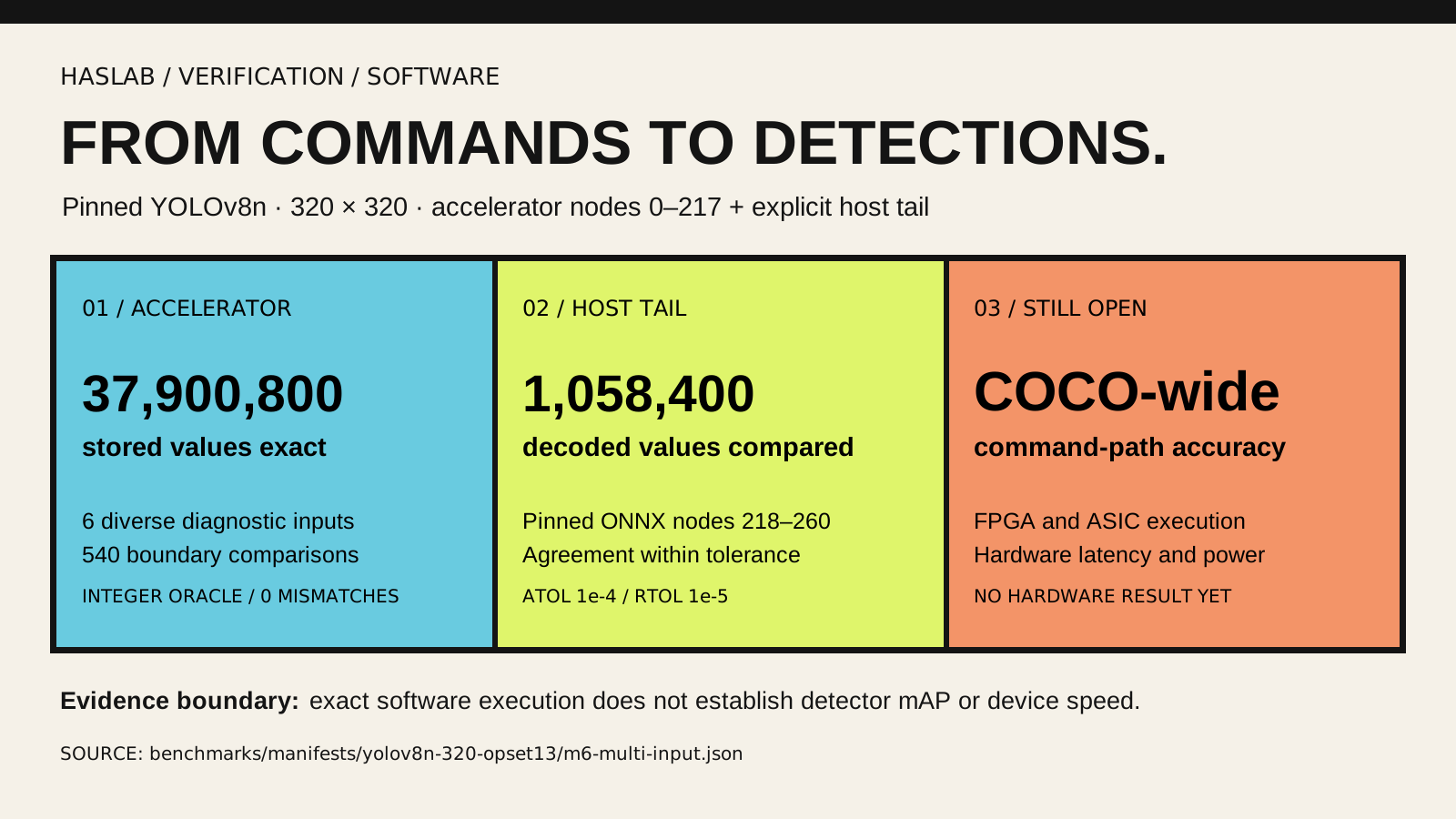
atol=1e-4 and rtol=1e-5; neither result is a COCO mAP or hardware-speed measurement. Source report ↗You do not need to understand the entire stack before contributing. Pick the layer closest to your interests and follow a short reading path.
Explore quantization, layouts, activations, and exact numerical semantics.
Start here →Review the v0 ABI, error behavior, and independent conformance fixtures.
Read the contract →Compare reference, FPGA, and future silicon profiles without overstating readiness.
Compare profiles →Add review, test vectors, workload analysis, documentation, or tool support.
Find useful work →HASLAB is an active work in progress. The reference model, simulator, and conformance foundation are ready to study today, while every future hardware capability will arrive with reproducible evidence.